
Maeve (1981) and the Rebellion of the Untranslatable Body

When Maeve premiered in 1981, the political climate in Northern Ireland was marked by volatility and fatigue. The hunger strikes had drawn international attention to the conflict, reinforcing the dominance of masculine narratives in representations of resistance. Into this space entered a film that refused both heroism and closure. Co-directed by Pat Murphy and John Davies, Maeve emerged from the newly forming wave of feminist cinema in Ireland, low-budget, intellectually rigorous, and structurally oppositional. Rather than conforming to the conventions of realism, the film deliberately fragments time, memory, and point of view.
It remains one of the most structurally radical and under-seen works in Irish film history. Despite its importance, Maeve continues to circulate outside of mainstream discourse, rarely cited in either national cinema studies or feminist film anthologies. Its relevance, however, is growing. In the aftermath of renewed interest in anti-colonial aesthetics and the politics of embodiment in cinema post-2023, Maeve offers an early and uncompromising model.
This essay argues that Maeve is not simply a film about Northern Ireland. It is a feminist and anti-colonial critique of how national memory is constructed and who it excludes. Through its rejection of linear narrative and its use of the female body as a site of protest rather than spectacle, Maeve stages a psycho-political challenge. It does not ask us to remember; it asks us to reconsider who owns the act of remembering.
“I’m sick of places that smell of other people’s memories”
Maeve’s complaint, “I’m sick of places that smell of other people’s memories”, arrives early, but it defines the film’s architecture. It is not simply a line of personal discontent; it is a political diagnosis. History, in Maeve, is not a shared inheritance but an imposed one. The quote distils the film’s central tension: between the memory that is lived and the memory that is demanded. Maeve returns to Belfast not to retrieve the past, but to resist the terms on which it is remembered.
From the moment the plane descends over Northern Ireland, Maeve stages landscape as a repository of inherited myth. Aerial shots of fields and coastlines are accompanied by her voiceover, not nostalgic, but observant, ambivalent. These images are not romanticised; they are mapped, as if Maeve is redrawing the contours of home from above, reclaiming space through distance. The land does not welcome her but imposes itself, strewn with markers of faith and loss: stone circles, roadside shrines, Marian statues. Religion and myth bleed into the soil. Belfast is less a city than a palimpsest of symbols.
What Maeve returns to is not memory, but memory-work, that is, a process of unpicking. Her mother, representative of a generation shaped by nationalist myth and Catholic piety, offers a version of the past that is clear, linear, and exclusionary. This is the logic of false memory, not invented, but selective. The mother’s Ireland is cohesive and pure; Maeve’s Ireland is contradictory and unstable. One rests in narrative, the other in rupture.
Here, Julia Kristeva’s theory of abjection becomes useful. In Powers of Horror, Kristeva describes the abject as that which is cast out to maintain identity, such as the maternal body, the unclean, the undigested past. Maeve experiences her home not as belonging, but as abjection: a place made unfamiliar by the excess of others’ memories. Her discomfort is not just political; it is visceral. Home is no longer a container for the self but a host for foreign projections.
The line about “smelling” memory is particularly significant. Smell, unlike sight, is involuntary. It signals how memory invades, how it bypasses reason. Maeve is not given the space to forget. She is made to breathe in the past of others and most often, these others are men: fighters, priests, fathers, public figures. Their memories are inscribed in the land, the rituals, the language. Maeve’s act of refusal is not to disown memory, but to expose its authorship.
In Maeve, the personal is not only political but architectural. The very landscape is structured by memory, and Maeve walks through it like an intruder in a house where she grew up but was never allowed to rearrange the furniture.

Unseen Violence, Occupied Bodies
Maeve is a film about violence, but not in the way audiences are conditioned to recognise it. Instead of spectacle, it offers absence. The most physically assertive moment in the film; Maeve punching a school bully, is never shown. It is referenced only through dialogue. This deliberate omission functions as a rejection of cinematic violence as performance. To show the punch would be to aestheticise it, to turn self-defence into choreography. By withholding the image, the film preserves its moral weight. Violence, when committed by women in Maeve, is neither punishment nor release. It is a refusal made visible through silence.
In contrast, the British soldier’s intrusion into Roisin’s bed is described in detail and partially staged but never eroticised. His desire is not mutual; it is institutional. The body becomes a substitute for his home, for nation, for permission. The soldier does not attempt to make love. He attempts to reassert a colonial intimacy by entering the domestic space and claiming proximity to femininity. What he seeks is not connection, but familiarity as an antidote to distance from his wife in England, his life, his origin. This encounter turns sex into a metaphor for post-colonial contact: unwanted, one-sided, and conditioned by structural power.
What is crucial in Maeve is who is seen and how. After sex, it is Maeve’s boyfriend who is fully exposed, not Maeve. He sits centre-frame, nude, inert. She remains dressed or partly covered. The camera does not fetishise her. Instead, it makes him the object of the gaze. This inversion is not played for provocation. It is simply filmed as if the reversal were normal. This is where Maeve distinguishes itself from both traditional cinema and some feminist counter-cinema. Rather than merely criticising the male gaze, it constructs a visual language that does not require it.
In her seminal essay Visual Pleasure and Narrative Cinema, Laura Mulvey argues that classical cinema positions women as passive objects of male desire, aligning spectatorship with male identification. Maeve disrupts this model by removing pleasure from view altogether. There is no scopophilic reward for the audience. Nudity is not an invitation, but a statement. The naked male body is not framed to incite arousal, but to restore balance. Maeve herself is never rendered fully visible in the terms patriarchal cinema demands. She is present but not possessed.
When Maeve states that the only form of protest available is through the body, she articulates a core truth of the film’s politics. Nakedness here is not sexual currency. It is a strategy. The female body is shown not as vulnerable, but as sovereign. It occupies space without apology. It does not need to please or explain. It exists as evidence of a history that refuses to be told through men.
This spatial and symbolic occupation draws a direct analogy between colonialism and patriarchy. The way English soldiers impose control on Irish land parallels the way men attempt to control women’s bodies. Both acts rely on entitlement, suppression, and narrative erasure. Audre Lorde and bell hooks have written extensively about the internalisation of oppressive gazes. When subjected to colonial violence, men often replicate domination within their own households. They do not dismantle or resist the structure; they relocate it.
Maeve refuses that relocation. It does not depict women as collateral damage of nationalist struggle, nor as emblems of cultural purity. Instead, it insists on the body as a contested site, where memory, sexuality, and resistance collide. It asks whether autonomy is possible within a system that always demands that someone else look at you.

Language, Gaze, and False Protest
Maeve is acutely aware that speech is not neutral. In the film’s most disorienting moments, a man speaks directly to the camera, unprompted, with calm authority. The scene is stark. His address breaks the film’s already disrupted narrative flow, invoking a Brechtian rupture that forces the viewer out of passive reception. This is not confession. It is performance. His monologue is uninterrupted, uninterrupted not because it is urgent, but because it is permitted. Maeve stages a subtle question: who is allowed to speak, and who is listened to when they do?
Maeve herself speaks often, but not in continuity. Her thoughts are fragmented, withheld, uncertain. She delivers soliloquies that feel closer to internal monologue than public statement. These are not narrative devices; they are acts of autonomy. Language, for Maeve, is a tool of clarification, but also a source of estrangement. It gives her agency, but it also isolates her. She is articulate but rarely heard. Where nationalist narratives rely on collective slogans, Maeve’s voice fractures meaning rather than condensing it. She does not chant. She thinks.
One of the film’s most striking exchanges occurs when an English soldier asks, “What’s Róisín Irish for?” and Róisín replies with irritation, “It’s not Irish for anything. It’s just Irish.” This sentence functions as a thesis. It suggests that meaning is not always derivative or representational. It challenges the colonial English assumption that other cultures require translation to be understood, or that they must justify their existence through English terms. This is more than linguistic arrogance; it reflects a deeper imperial logic, one in which cultures like Ireland or Wales are only recognised through their relation to Englishness. The irony, of course, is that Irish and Welsh civilisations predate English culture, and England itself, by over a thousand years. Róisín does not need to be translated to matter. Some things do not stand in for others. They simply exist.
Róisín, like Maeve, is not a metaphor. She is not a symbol for the nation. She is not a conduit for male grief or colonial nostalgia. She is Irish, without qualification. She is the thing itself. The character is a bold one who answers back and mocks the English soldiers and even when man-handled she refuses their intimidation.
Even the name Maeve resists assimilation. Though its spelling is anglicised from Medb, it retains the phonetic strangeness that frustrates English speakers. Like Niamh or Siobhán, it marks a boundary between languages that cannot be crossed without resistance. These names require patience, effort, mispronunciation, and confusion, but only for the alien, that is, for the colonial presence, in which the names serve as a quiet reminder that they are not at home. They do not belong here. The difficulty is not a flaw in the name; it is the name’s refusal to accommodate. In Maeve, this linguistic friction becomes another form of protest. Not all acts of resistance are spoken. Some are simply not translated and in doing so the phonetic struggle of Aoife becomes as devastating as a rifle.
That resistance is complicated by the name’s mythological weight. Queen Medb of Connacht, from the Ulster Cycle, was a warrior monarch often interpreted as a sovereignty goddess bestowing the right to rule upon those who united with her. Over time, she became a shorthand for the feminine embodiment of Ireland itself: powerful, sexual, symbolic. In naming its protagonist Maeve, the film conjures that lineage only to refuse it. This Maeve is not a divine archetype. She does not bestow sovereignty. She does not exist to complete a national myth. She withdraws from it. If the mythic Medb made men kings, Pat Murphy’s Maeve denies them even the narrative.
This refusal of metaphor is echoed in one of the film’s most loaded sequences: a group of men in a pub discussing male violence, surrounded by traditional Irish instruments and songs. The scene is uncomfortably long, held in lingering frames that call attention to cultural performance as repetition rather than reflection. The drum, the fiddle, the pub, all the props of national identity, become part of the denial. The conversation circles violence but never indicts it. Patriarchy, here, is not interrogated. It is passed around like a pint, something shared and never questioned.
In this context, protest becomes another form of control. The Irish nationalist movement, particularly as represented in mid-century propaganda and documentaries like The Patriot Game, often cast women as symbols and silence as strength. Maeve challenges this by refusing silence but not replacing it with certainty. It does not correct the story of Ireland. It refuses to tell it in the way we expect.
The film is not concerned with resolution. It is concerned with authorship. Who writes the script of national identity? Who performs it? And who, finally, is allowed to stop?
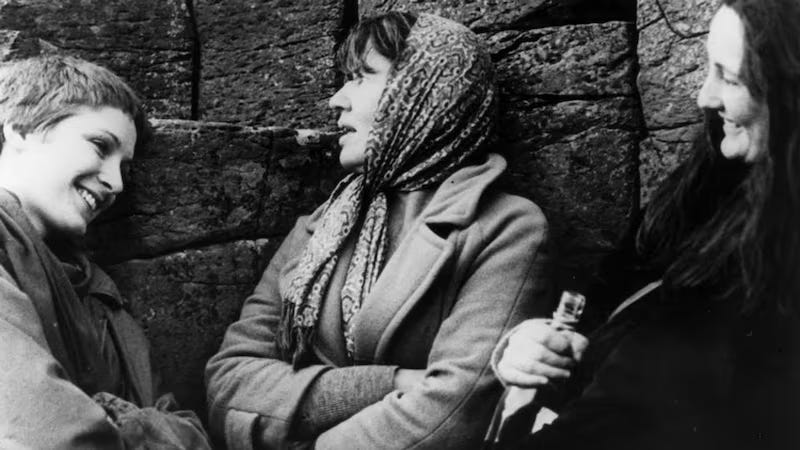
A Feminism Beyond the Frame
Maeve is a film that refuses realism to expose what realism conceals. Its fractured structure, temporal dislocation, and absence of dramatic resolution are not signs of incompleteness. They are its critique. Pat Murphy does not attempt to recreate the past. She dismantles the terms on which it has been remembered. The result is not a historical drama, but a cinematic argument. The script and mis-en-scene read like prose, not because they are literary, but because they insist on interiority. It treats language not as ornament, but as weapon.
Whether Maeve is primarily a protest against English colonialism or a deeper reckoning with internalised violence is ultimately beside the point. It is both. It examines how patriarchy and imperialism co-produce each other, and how women are forced to carry the weight of both. In this way, Maeve anticipates conversations still unfolding in 2025 around the politics of representation, the exhaustion of spectacle, and the limits of symbolic protest.
There are no martyrs here. No national heroes. No cinematic climax. Instead, Maeve offers a different model for what a national cinema might look like: one that centres silence, fragmentation, and refusal. It does not perform trauma. It interrupts it.
The film’s most radical gesture is not what it shows, but what it withholds. In doing so, it reminds us that the body remembers what the nation forgets and that sometimes, the only form of protest left is to become untranslatable.
References
hooks, b. (1992). Black looks: Race and representation. South End Press.
Kristeva, J. (1982). Powers of horror: An essay on abjection (L. S. Roudiez, Trans.). Columbia University Press.
Lorde, A. (1984). Sister outsider: Essays and speeches. Crossing Press.
Mulvey, L. (1975). Visual pleasure and narrative cinema. Screen, 16(3), 6–18. https://doi.org/10.1093/screen/16.3.6
Murphy, P. (Director), & Davies, J. (Co-director). (1981). Maeve [Film]. BFI Production Board.
Pollock, G. (1988). Vision and difference: Feminism, femininity and histories of art. Routledge.
Trinh, T. M. (1989). Woman, native, other: Writing postcoloniality and feminism. Indiana University Press.
Goldsmith, B. (1993). The Patriot Game [Film]. C4 & Trade Films.
Koch, J. (2006). Rewriting the Troubles: Feminist visibility in Pat Murphy’s Maeve. Irish Studies Review, 14(2), 205–219. https://doi.org/10.1080/09670880600722531
Ó hÓgáin, D. (2002). The Lore of Ireland: An Encyclopaedia of Myth, Legend and Romance. The Boydell Press.
Subscribe to The Quiet Axis for more psychoanalytic film essays.
Comment if you’ve seen Maeve, or if you think the body can ever be decolonised.
Leave a Reply