
TIFF50
What may appear to be yet another Iraqi film lamenting trauma and the devastation of war becomes, through Mohamed Al-Daradji’s vision, a layered fable of legend, myth, and survival. Irkalla: Gilgamesh’s Dream is a love letter to literacy and to the armour of dreams. Its gaze is binary, showing what has been lost, but seeing what endures: the river, the written word, and the imagination of children who refuse to be defeated by the mistakes of adults.
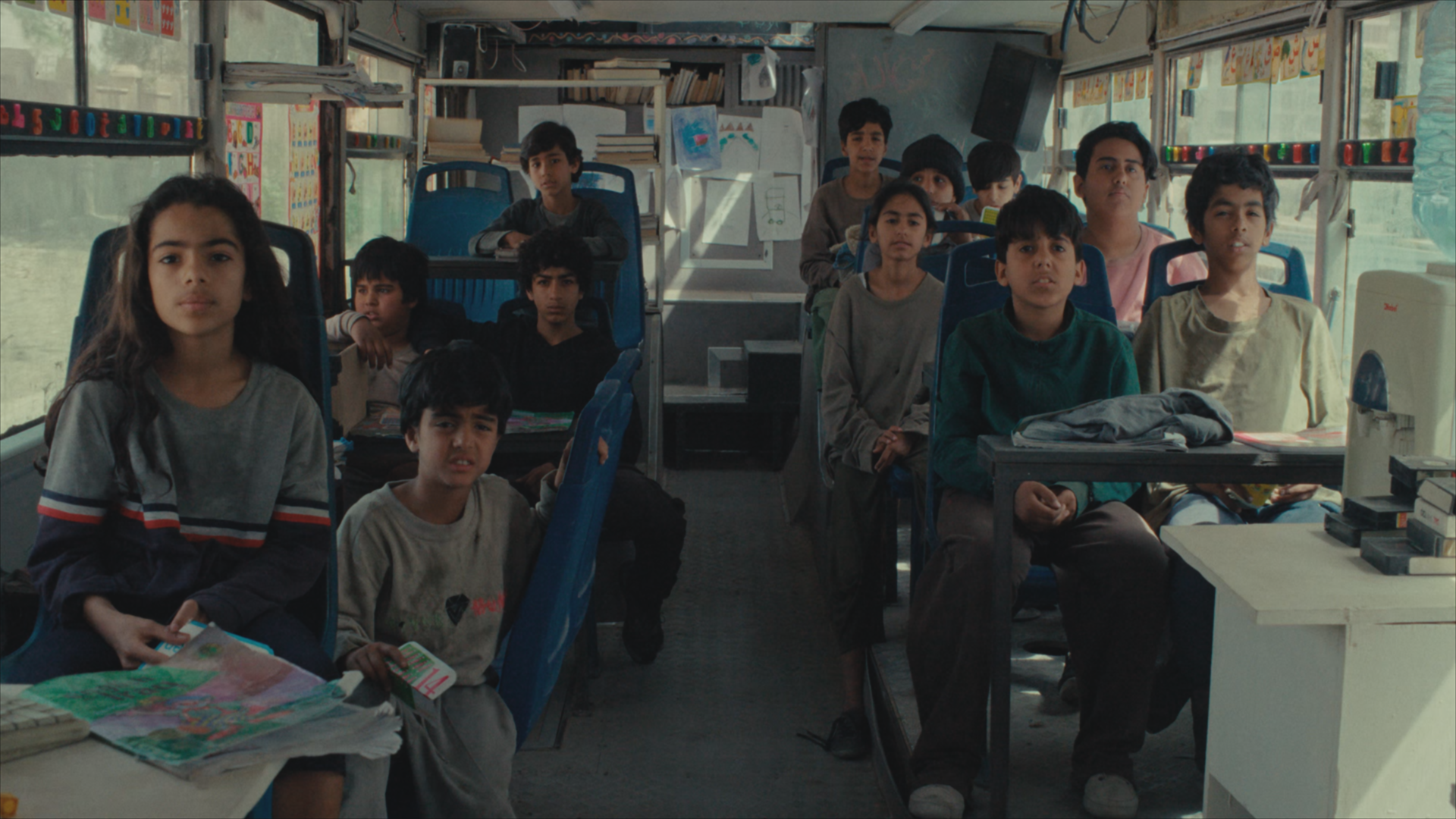
Set in Baghdad, October 2019, the film follows Chum-Chum, a nine-year-old homeless boy who believes the Tigris hides a gateway to Irkalla, the underworld where he might resurrect his parents. His best friend Moody is drawn into militia violence, while Maryam, a grief-stricken teacher, drives a mobile classroom through the city, teaching children on the edge of collapse, albeit propped up by love for their classmates and the free lunch. Through these intersecting paths, Al-Daradji blends myth and politics, protest and poetry, into a cinematic tableau.
When Al-Daradji informs us the story ‘chose him,’ he points to the kind of tale that does not merely get written but insists on being told. In Iraq, the land of Gilgamesh, where the first stories were etched in clay, narratives feel less like invention than inheritance. They can arrive as burdens, as hauntings, and as calls to keep memory alive as the oral tradition did before Iraq gave the world the first written word.
Al-Daradji told The Quiet Axis that the inspiration for one of the film’s core motifs, Miss. Maryam’s refurbished double-decker mobile classroom, lay in a news report about a woman in India who drove a bus to gather children and teach them. For him, that image became a metaphor for Iraq’s most urgent need: “education, education, education”. Maryam’s classroom bus carries the same symbolic weight as a fragile vehicle of literacy moving through streets scarred by unrest. For Al-Daradji, this is not just social realism but a reminder of Iraq’s literary heritage. As he put it, this is the land where the first story was written, where Gilgamesh himself was carved into clay. To connect Chum-Chum’s grief with that tradition is to insist that storytelling itself, and the dreams they are born from, can be the greatest act of survival mirroring the thesis of Gilgamesh; kings may turn to dust, governments may fall, but stories carved in stone endure forever. Indeed throughout the film Moody is often referred to as malik (king) serving as both affirmation of his status and potential foreshadowing of his fate.

The film’s imagery makes that claim visceral. The Tigris is not merely aesthetic or collateral backdrop but life-force; its currents both promise and wound. Bridges appear as sites of protest, violence, and passage, staging Iraq’s contemporary upheaval while echoing the mythic thresholds of Gilgamesh. Where lives are shattered, the river and the written word endure as testaments of a culture that cannot be erased.
Against this setting, Chum-Chum’s resilience is cast in sharp relief. Though his body is at the mercy of insulin, his dreams sustain his spirit. When Maryam tells her students, ‘You are from Baghdad, so don’t dream,’ her words echo not as surrender but as a challenge to dream harder. His dreams of Gilgamesh are the antidote to tragedy, drawn into his bloodstream like insulin itself. Even the medicine that keeps him alive is cast in mythic terms, Maryam, empowered by grief, seizing it in anger from the chemist, and Moody later stealing it as the man sleeps like a dragon guarding gold. These moments recall ancient quests where survival depends on breaking boundaries, from Prometheus stealing fire to Gilgamesh diving for the plant of renewal. In Baghdad’s modern epic, medicine becomes myth, and survival rests on defiance of the rules.
Al-Daradji insists he does not consider how Western audiences might interpret the violence or trauma as a possible reinforcement of the stereotype of contemporary Iraqi cinema. “I’m happy if my family enjoys it ,” he told us, describing his aim as reflecting “the beauty of humanity.” That sincerity comes through in his work with the cast, all of whom are non-professionals. Their emotions are unvarnished, often raw to the point of discomfort. Some scenes will overwhelm the audience to visible grief, not through the manipulation of sound or classically trained acting but through children whose pain appears not to be simulated but remembered. To capture Moody’s streetwise instincts, Al-Daradji even sent young actor Hussein Raad Zuwayr out to earn five dollars on his own, a task so successfully achieved (he came back with ten) that it honed the restless edge visible on screen.
The Netherlands, where Al-Daradji studied film, gave him, in his words, “the freedom to find myself as a filmmaker.” It surfaces here as an earthly dream image of escape for Moody, a counterweight to Baghdad’s claustrophobic cycles of violence and relentless hustling and a binary tension to Chum-Chum’s mythic dreams. Yet the film is not escapist. It is a return, as Al-Daradji says, to the “missing tablet” of Gilgamesh and the imagined page where grief and longing are inscribed anew.
The closing movements compress some arcs, yet Chum-Chum’s catharsis remains the film’s true centrepiece. These echo the subject itself: stories cut short, lives interrupted. What the film offers in return is a stubborn lyricism, a belief that imagination can still carve meaning into rubble.
Irkalla: Gilgamesh’s Dream is not another lament, it is a waking dream and like Gilgamesh’s carved words, it insists that what endures begins in our dreams.
Leave a Reply