
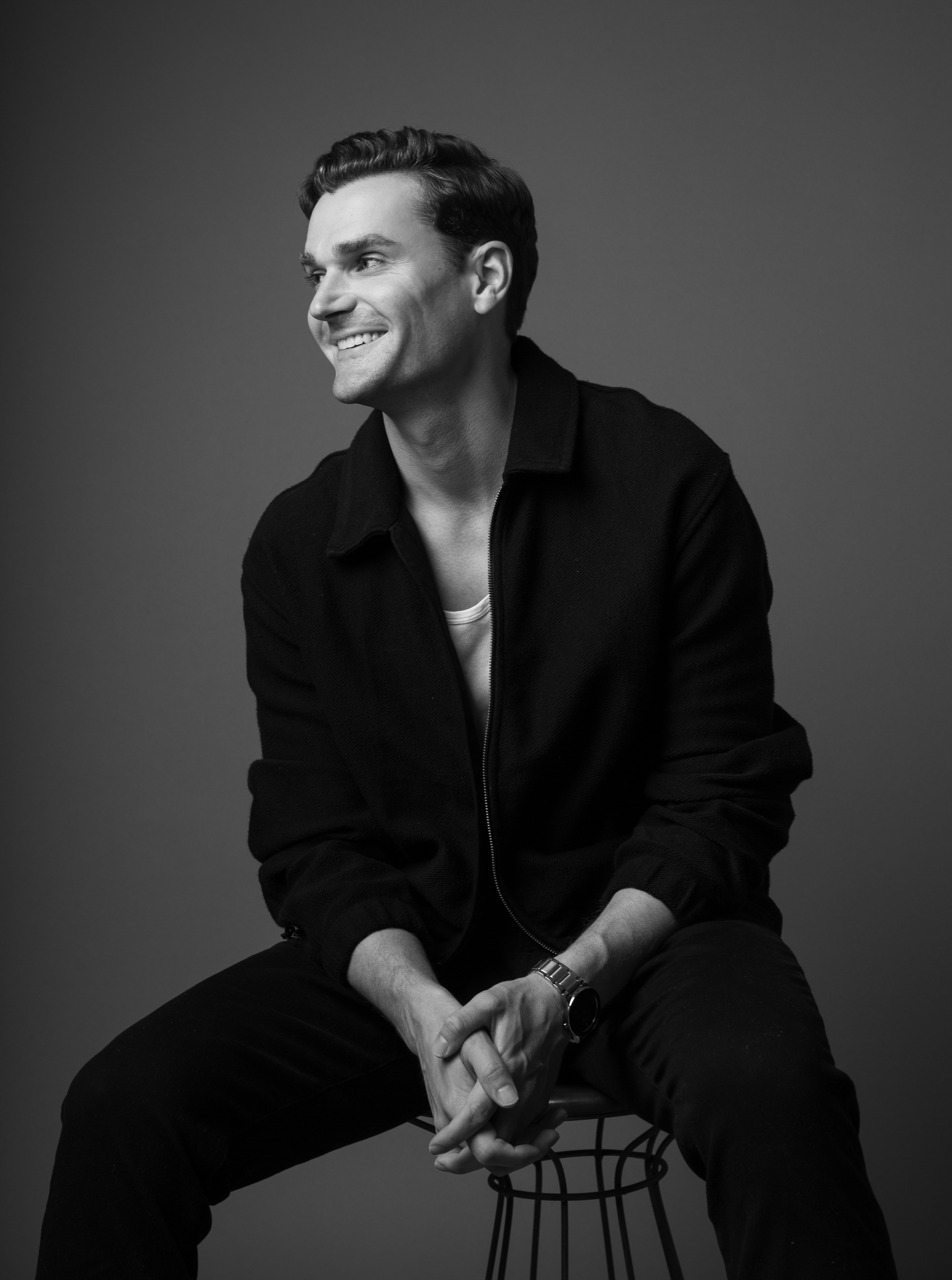
Ryan Green
Blake Winston Rice is a writer and director whose work explores character, intimacy, and emotional pressure through restrained narrative frameworks. After beginning his career as an actor and comedian, he shifted to filmmaking in the late 2010s. His short film Tea premiered in Competition at the Cannes Film Festival, marking a breakthrough moment in his career. His work has since screened internationally.
His latest short film, DISC, approaches intimacy and connection through narrative constraint rather than spectacle. Set within a confined, high-pressure scenario, the film foregrounds emotional proximity while resisting explicitness. In the conversation that follows, Blake reflects on restraint, intimacy, and the mechanics of connection under pressure and why those choices sit at the centre of the film’s emotional impact.
Rialto:
I watched DISC this week, and I’m still processing it.
Blake:
That’s what we want. Let it cook.
Rialto:
I think that’s often the sign of a good film. If you’re still processing it days later it shows how layered it is. I have my own interpretations, but I’m interested in how you would describe it. Not literally what happens, but how you see it.
Blake:
To me, it’s a dramedy about connection. We talk about this a lot, but it’s really about intimacy in a way that flips expectations.
You can have a one-night stand and not connect at all, but a totally unexpected scenario can force real connection. Not only with another person, but with yourself.
The goal was to put these two characters into an intimate space and let them fully arc in a very short amount of time. To experience a full range of emotions. That’s why I wanted to make it and show it to people.
Rialto:
That leads perfectly into something I noted. It’s intimacy without eroticism. It’s not sexualised.
How conscious was that balance when you were making the film? Because it would have been easier to be explicit, but you clearly chose not to.
Blake:
On a surface level, I think it’s more provocative to let it live in your head. I’m not showing the shark.
It’s scarier to imagine. We only show the most graphic image right at the very end, when the disc is removed for a split second. And even that becomes a kind of release.
That’s a metaphor for the whole thing. It wasn’t as bad as you imagined. They survived it.
Showing more would have cheapened it. I’m not making a movie about reproductive health. I’m making a movie about two people in a scenario.
Going more graphic would have been the easy choice. Less interesting.
Rialto:
That makes sense. It could easily have slipped into body horror.
Blake:
Exactly. And personally, I’m squeamish. I didn’t know much about the topic going in.
Playing that up, especially through Jim’s character, helped ground it in authenticity.
It just felt more honest not to show everything.
Rialto:
That one graphic moment at the end works because of the restraint.
It made me think of The Substance and Coralie Fargeat’s earlier short Reality. She developed that idea over ten years.
Do you see this as something contained, or something you might expand later?
Blake:
The themes, absolutely. The exact story, probably not.
I don’t write for genre. I write for the audience journey. Two people starting apart, finding each other, laughing, crying, hurting.
I love a warm ending, and that will carry into my next work, especially as I move into feature length.
Do I have a feature version of this yet? Not exactly. But you’ll get credit when I make Disc Two.
Rialto:
I’ll take that!
Blake:
Shorts are learning opportunities. They’re also business opportunities.
I’ve learned a lot from this one. There are things I’d do differently, but there are also takeaways I’m already applying as I level up.
Festivals like Clermont Ferrand, TIFF, Cannes, all open doors.
Rialto:
On Cannes specifically, what did that mean for you as a filmmaker?
Blake:
It meant the world. Same with Toronto.
When you’re early in your career and don’t have many options, festivals are the strategy. Cannes opens doors not just that year, but for your whole career.
People bring up that short in meetings. Now they bring up two. It lets you talk features, meet reps, do press.
It also gave me confidence. Not complacency. It gave me what I call belly fire.
If I got in with this short, I’m coming back with something bigger. A feature.
I’m incredibly grateful to Cannes, Toronto, Clermont. They all matter, especially as I grow internationally.
Rialto:
Making films at the beginning is hard, and creative work is often a struggle. Why do you still choose it?
Blake:
Because I love it.
I come from a sports background. The pursuit of greatness matters to me. I’m trying to be great. I’m trying to be Spielberg.
I want to make movies that sell tickets and move people. This is my only door in.
There are no shortcuts. You have to sacrifice. You have to double down.
Maybe I’m a little messed up, but I enjoy the struggle. I love the craft.
I love writing, prep, shooting, cutting, then moving on and learning from it.
I tried comedy, stand-up, acting. Directing and writing were the things that kept me up at night. That’s how I knew.
Rialto:
When people talk about you in the future, how would you want them to describe you as a filmmaker?
Blake:
I love filmmakers who get critical acclaim and box office success. That’s the line I’m chasing.
I want to make you scared, make you laugh, make you cry, and make you learn something.
Genreless, but entertaining. Ambitious, yes, and I’ll miss steps along the way.
But I’m not trying to make films just for filmmakers. I’m trying to make movies for everyone.
Rialto:
We’ve got about a minute left. Can you share anything about what’s next?
Blake:
I can say this. I have my first feature in development. It’s called The Empty Lot, with Wild Atlantic Pictures in Ireland.
That’s about as much as I can say for now, but I’m excited to come back and talk about it.
I also produced a short called Prime that premieres at Sundance in two weeks.
I’m grateful. Very grateful.
This interview has been edited for clarity and length.
Leave a Reply