
How America Learned to Manage Crisis Instead of Resolving It

American cinema once believed that crisis led somewhere. This was less a matter of ideology than of narrative grammar: a shared assumption that pressure, when intensified, would force decision and produce consequence.
Pressure clarified and confinement forced decisions. A race against the clock produced truth, courage, reform, or collapse. From courtrooms to prisons to besieged towns, crisis functioned as a narrative engine that moved stories forward and, more importantly, reassured audiences that something decisive would happen if they just held on long enough until the pressure became unbearable.
That belief does not survive the 1970s. The collapse is not aesthetic alone but historical, shaped by Vietnam, Watergate, and the growing visibility of institutions that absorbed crisis without reforming themselves.
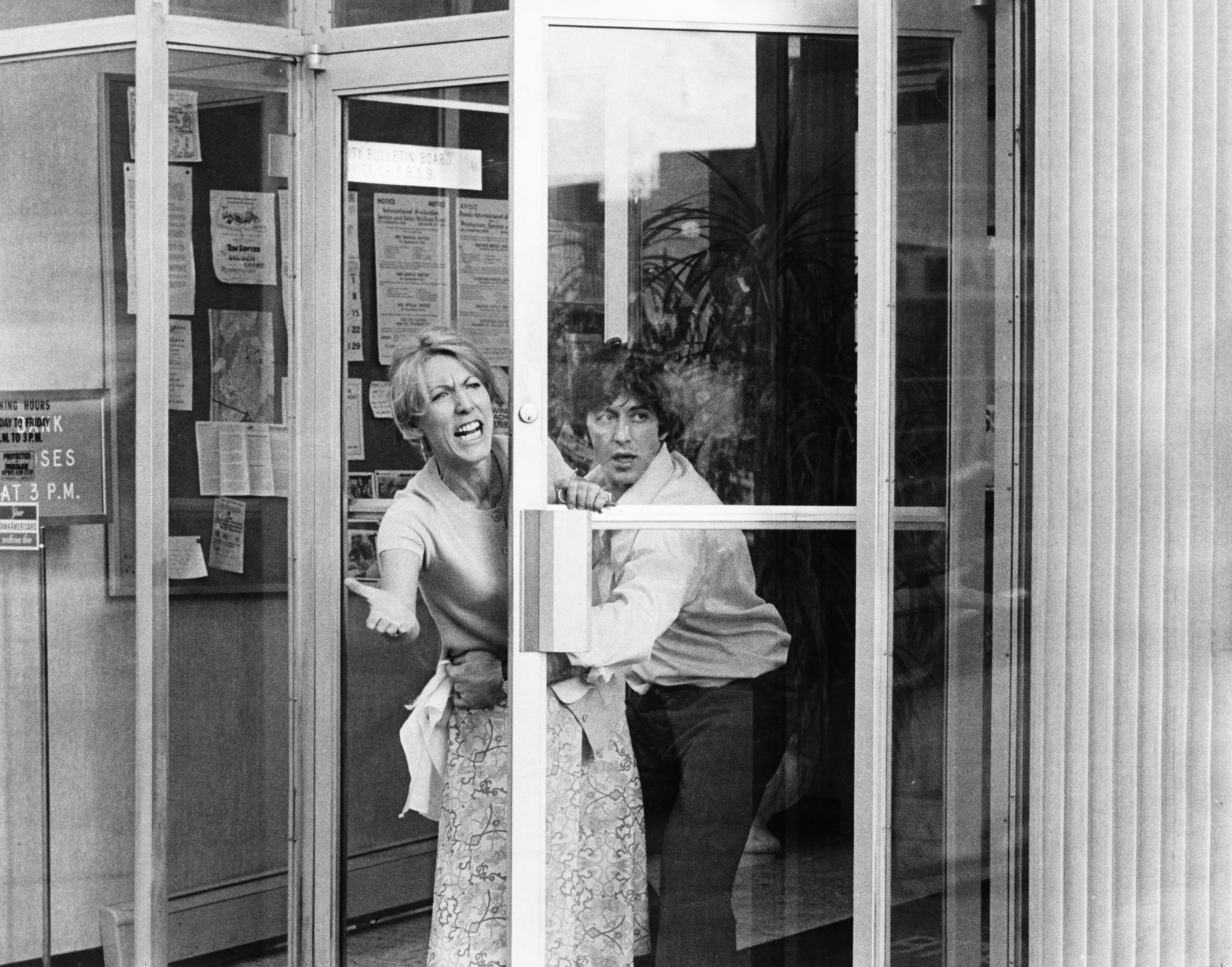
One of the first films to register its collapse is Dog Day Afternoon. Often described as a gritty New Hollywood crime drama or a character study anchored by Al Pacino, the film is more radical than its reputation suggests. It does not simply depict a failed robbery but stages a new relationship between crisis, institutions, and the public. A relationship in which pressure no longer leads to resolution, and confinement no longer produces clarity.
To understand why this matters, it is first necessary to establish what American cinema believed before Dog Day Afternoon, and what precisely changes when that belief breaks.
Crisis as engine: what carceral cinema used to do
Classical American cinema repeatedly places characters under extreme pressure in confined spaces and treats that pressure as productive. This is true not only of literal prison films, but of a much broader narrative logic that can be described as carceral cinema.
Carceral cinema is not defined by prisons alone but defined by a belief that physical or institutional confinement generates narrative movement. What distinguishes it from narrative tension more generally is the expectation that confinement must culminate in moral, legal, or existential resolution. The walls matter because they force confrontation. Time matters because it compresses and limits choice, and authority matters because it must be challenged, obeyed, or overthrown. Such is life.
Consider 12 Angry Men. The jury room functions as a temporary prison. The men cannot leave until a verdict is reached and the film’s faith lies in the idea that pressure produces deliberation, deliberation produces truth, and truth produces justice. Confinement works.
The same logic governs High Noon. Time pressure exposes moral character. The crisis escalates towards a showdown that clarifies cowardice and courage. Resolution is not optional. It is demanded.
Even prison films that end pessimistically retain this structure. Cool Hand Luke believes that resistance matters precisely because confinement is total. The walls define the stakes, and the pressure gives meaning to defiance.
Across genres, the assumption holds. Crisis accelerates narrative and confinement forces consequence. Something must give.
This logic persists well into the 1960s. Liberal consensus films such as To Kill a Mockingbird or In the Heat of the Night still treat crisis as a mechanism for moral recognition and incremental change. Institutions may fail, but confrontation leads somewhere.
Even early New Hollywood cinema retains faith in crisis as revelation. The Graduate imagines rupture through pressure. Easy Rider ends violently, but the journey is still framed as meaningful. Crisis may destroy, but it does not stall.
This is the belief structure Dog Day Afternoon quietly abandons.
The crack in the model
By the early 1970s, American cinema begins to sense that pressure no longer guarantees outcome. Institutions appear bloated, procedural, and strangely resistant to change. Exposure does not reform. Confrontation does not resolve.
Films like Serpico depict whistleblowing as an act that damages the individual while leaving the system intact. The Parallax View presents power as dispersed, anonymous, and impossible to confront directly. Investigation becomes a corridor without an exit.
These films still believe in revelation, but the old carceral logic is weakening. Pressure produces information, not transformation.
Dog Day Afternoon arrives at this fault line and steps fully across it.
From carceral to neo-carceral
What Dog Day Afternoon introduces is not cynicism, but a different model of containment. The film shows what happens when confinement no longer concentrates power, but diffuses it or when crisis is not a crucible but a condition to be stabilised.
To describe this shift, it is useful to distinguish between classical carceral cinema and what can be called neo-carceral cinema.
Neo-carceral cinema describes films in which the primary trap is not walls, but process. Space may be contained, but it is porous. Authority is not embodied in a single figure, but distributed across roles, departments, and procedures, and crisis does not escalate towards resolution. It plateaus. The defining feature is not bureaucracy itself, but the suspension of consequence, and the sense that procedures exist precisely to prevent decisive endings. Time stretches instead of compressing. Visibility replaces punishment. Management replaces confrontation.
In neo-carceral cinema, nothing forces an ending.
Dog Day Afternoon as archetype
Dog Day Afternoon is the archetypal neo-carceral film because it stages this logic with exceptional clarity.
The bank is not a prison. People enter and exit. Phones ring. The media arrives. Information flows freely. The space is contained but permeable. This immediately breaks classical carceral expectations.
Power does not appear as a single authority. There is no warden, no judge, no decisive antagonist. Instead, power takes the form of negotiators, psychologists, police spokespeople, logistical planners. Each interaction delays resolution. Deadlines are set, revised, extended. Demands are discussed, rephrased, softened.
Time, which once forced decision, now neutralises it. The longer the crisis continues, the less imaginable change becomes. The narrative does not accelerate. It stabilises.
Outside the bank, a crowd gathers. They cheer. They chant. When Sonny invokes Attica, the response is electric. Yet nothing follows. The crowd does not act. It reacts. It becomes an audience. Public energy is not suppressed. It is contained through spectacle.
Visibility, therefore, functions as discipline. Sonny is not punished physically. He is captured narratively. Once his story is legible, it becomes manageable. Legibility does not save Sonny, but it neutralises him, converting a volatile threat into a knowable case that can be processed, narrated, and closed. Exposure does not empower but fixes him in place.
This is neo-carceral containment. Not confinement through force, but through endless process.
Why Sidney Lumet matters
That Dog Day Afternoon arrives at this insight is inseparable from the background of its director, Sidney Lumet.
Lumet was born in New York City in 1924 to parents who were actors in Yiddish theatre. He grew up backstage. His formative training was not in European art cinema but in theatre and live television drama. In the 1950s, he directed live broadcasts where everything unfolded in real time, where mistakes could not be corrected, and where tension came from duration rather than montage.
Lumet was also a liberal institutionalist rather than a revolutionary. His films repeatedly stage courts, police departments, unions, newsrooms. He believes institutions matter, even as he exposes their failures. This is precisely why Dog Day Afternoon is so unsettling. Lumet’s importance lies less in his biography than in his method: a commitment to duration, procedure, and institutional space as the primary sources of tension. It is not a radical fantasy. It is an institutional x-ray.
The film’s restrained style, including its near absence of non-diegetic music, is not an aesthetic flourish but an ethical refusal. Lumet does not provide emotional guidance. He allows time to accumulate. The lack of musical release reinforces the sense that nothing will rescue the situation from its own procedures.
The theatre-like quality of the film, therefore, reflects Lumet’s background, but its function is not theatricality for its own sake. It serves the neo-carceral logic. Everything happens in front of us, in duration, without escalation or catharsis. What you see is what you get.
Neo-carceral cinema beyond Dog Day Afternoon
A concept only earns its keep if it explains more than one case. Neo-carceral cinema does. Each of the films that follow differs in tone and politics, but they share a refusal to allow crisis to collapse into decisive transformation.
Network shows how institutional systems do not silence dissent, but absorb it. Outrage is converted into programming. Crisis becomes a format. Exposure does not destabilise the institution. It feeds it.
All the President’s Men replaces heroic revelation with procedural labour. Truth emerges slowly through documentation, verification, and institutional inertia. The drama lies in process, not catharsis.
Michael Clayton presents crisis as legal choreography. The threat is not violence but reputational management. Power operates through internal containment and administrative delay.
Contagion depicts crisis as protocol. The narrative is shaped by models, briefings, queues, and public messaging. There is no villain to defeat, only systems to coordinate. Resolution is managerial, not emotional.
Across these films, the same pattern recurs. Crisis is stabilised, narrated, and prolonged. Authority is decentralised. Time stretches. Attention is demanded without resolution.
This is not simply “contained cinema”. Films like The Shining or Poltergeist also confine their characters to predominantly single locations, but they remain mythic and expressive. Confinement in those cases leads to eruption, whereas Neo-carceral cinema leads to stabilisation.
Why neo-carceral cinema matters now
Neo-carceral cinema helps explain a contemporary political feeling that is widely sensed but rarely articulated: these films do not merely reflect this condition but rehearse it, training audiences to recognise crisis as something to be watched, managed, and endured rather than resolved. Although everything arrives framed as urgent, almost nothing is allowed to conclude, and the accumulation of crisis produces not clarity or action but a low-grade exhaustion. Attention, in this environment, is no longer voluntary. It is treated as a civic obligation, continually summoned through alarm and spectacle, while outrage, repeatedly activated, burns itself out rather than translating into mobilisation.
Within this condition, modern political leadership has drifted toward performance, as figures who can command visibility and sustain attention are rewarded over those capable of resolving structural problems. Competence becomes secondary to watchability, policy to personality, and qualification to charisma. We have not simply tolerated this shift; we have normalised it, because in a system organised around compulsory attention, the most effective actors are not those who govern well, but those who keep the crisis alive and the audience engaged.
Dog Day Afternoon does not predict the modern world. It shows its conception.
The uncomfortable lesson
Dog Day Afternoon offers no solutions, but it does offer clarity, showing how crisis can operate as a mode of governance and how emotional engagement, however intense, does not necessarily translate into agency or power. This is not a counsel of despair so much as a call for discernment, an insistence that recognising the structure of crisis is a prerequisite for responding to it meaningfully.
If crisis is endlessly staged and continually refreshed, then learning to recognise the performance becomes the first act of agency, because not every emergency deserves attention and not every spectacle warrants reaction. Cinema once trained audiences to believe that crisis, when pressed hard enough, would produce change. Neo-carceral cinema teaches a more unsettling lesson: that crisis can persist indefinitely, managed rather than resolved.
Understanding that distinction is not an exercise in nostalgia, nor a lament for lost certainties. It is a necessary step toward regaining perspective in a world organised around permanent emergency.

Leave a Reply