
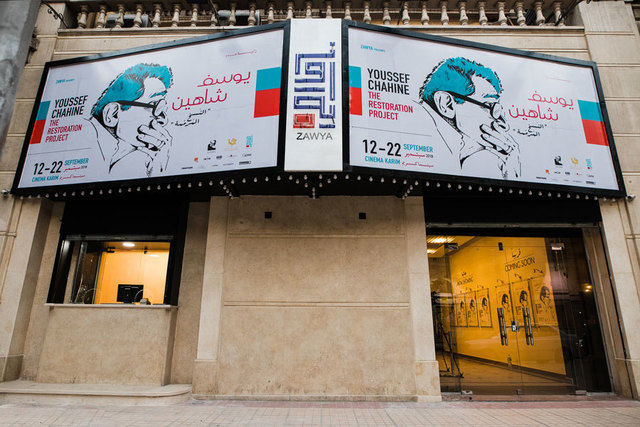
In Africa’s largest city, serious cinema survives in a single room
On a quiet evening in Downtown Cairo, the lights dim inside a modest screening room on Emad El-Deen Street. The film about to begin will not trend on Egyptian social media, nor will its actors appear on billboards across the city. It is subtitled, restrained, and demanding of attention. In most capitals, this would be unremarkable. In Cairo, it is an exception.
Zawya Cinema has spent the past decade building a space for films that exist outside Egypt’s commercial mainstream. Its name, derived from the Arabic for “corner” or “perspective”, is quietly instructive. In doing so, it has become something more than a venue. It is a workaround. A single, fragile answer to a larger absence: the lack of a functioning ecosystem for serious cinema.
This absence is not accidental. Egypt possesses one of the most historically significant film industries in the Arab world, yet its contemporary theatrical landscape is overwhelmingly shaped by commercial imperatives. High-volume comedies, slapstick capers, star-led vehicles, and seasonal releases dominate screens, reinforced by marketing cycles that leave little room for alternative programming. Films that fall outside this model are often confined to limited runs or one-off screenings, with little continuity in distribution or exhibition. The result is not the disappearance of serious cinema, but its displacement.
Zawya occupies that displaced space. It programmes independent Arab films, European festival titles, retrospectives, and occasional restorations. It introduces Cairo audiences to work that would otherwise remain inaccessible, not because such films are unavailable globally, but because there is no consistent local infrastructure to support their circulation. In this sense, Zawya functions less as a cinema in the traditional sense and more as an intermediary between Cairo and a wider film culture that exists elsewhere as a matter of course.
Yet its importance should not be overstated. Zawya’s significance lies not in being the only space for such films, but in being the only one that sustains them with consistency. It operates within the physical shell of an older downtown cinema, its screenings limited in number, its audience relatively small and self-selecting. It does not reshape the broader market, nor does it fundamentally alter audience habits at scale. If anything, it reveals how entrenched those habits are.
This tension between necessity and limitation is what defines Zawya’s position. It exists because there is demand, however modest, for films that fall outside the commercial mainstream. At the same time, its continued singularity suggests that such demand has not yet translated into a broader cultural shift. Cairo, a city of over twenty million people, relies on a single platform to sustain a certain kind of cinematic experience. That fact alone is instructive.
The problem is not simply one of supply, but of cultural infrastructure. In cities where film culture is more robust, serious cinema is not confined to a single venue or brand. It is distributed across repertory cinemas, film societies, university programmes, and independent exhibitors. It is reinforced by criticism, by education, and by a critical mass of audiences accustomed to encountering it. Cairo’s system, by contrast, offers little continuity between production, distribution, and exhibition outside the commercial sphere, a sharp contrast to the city’s own cinematic past when theatres and film culture were more deeply embedded in urban life. Zawya bridges that gap, but it cannot replace the system that should exist around it.
There is also a question of audience. Zawya’s viewers are not representative of Cairo at large. They are typically younger, urban, and educated, often already predisposed towards international or independent cinema. This is not a criticism so much as a structural reality shaped by access, language, and exposure. Films that require subtitles, cultural context, or slower narrative rhythms tend to attract those who have already developed the literacy to engage with them. Without broader exposure or institutional support, that audience remains limited.
This dynamic speaks to a deeper issue within cultural consumption. Audiences rarely choose what they are not accustomed to seeing. In environments where commercial cinema dominates, alternatives must be actively introduced and sustained over time. Zawya performs that function, but largely in isolation. It is both an entry point and a boundary.
And yet, its existence matters. Not because it represents a thriving alternative, but because it prevents a total absence. It ensures that Cairo remains, however tenuously, connected to a global film culture that values diversity of form, language, and perspective. It offers filmmakers a space, however small, where their work can be seen in the conditions it was intended for. It provides audiences with the possibility, however limited, of encountering something different.
The question is not whether Zawya is successful. It is whether it should have to carry this role alone.
In the end, Zawya is less a symbol of what Cairo’s film culture is, and more a reminder of what it is not. Its continued presence suggests both resilience and deficiency, a cultural life sustained not by systems, but by exceptions. In a city of its scale and history, that should not be enough. The question is how long it can continue to be.

Zawya Cinema programmes and listings can be found at zawyacinema.com
Leave a Reply